
Preserving Corporate Wealth for the Next Generation
A Professional Services Estate Planning Case Study
Client Profile
Andrew Collins is the founder of a Toronto-based engineering consulting firm specializing in structural design and project advisory for commercial and mid-rise developments across Ontario.
- Founder age: 61
- Annual revenue: ~$2.4M
- Employees: 12
- Children: Two teenage children
- Assets: Significant corporate retained earnings and investment portfolio
Asset Structure
- Principal Residence (Personally Held): Fair market value: $3.1M; fully protected by the principal residence exemption
- Operating Company (OpCo): Enterprise value: ~$3.5M; high-margin consulting business with a strong recurring client base
- Holding Company (Holdco): Fair market value: ~$2.7M; investment portfolio of equities and fixed income built from retained earnings accumulated over many years
Projected Estate Tax Exposure
Upon Andrew’s death, his shares in OpCo and Holdco would be deemed disposed of at fair market value. Modeled capital gains tax exposure resulted in an estimated estate tax liability of approximately $2.5M.
The issue was not investment performance.
The issue was liquidity and tax efficiency.
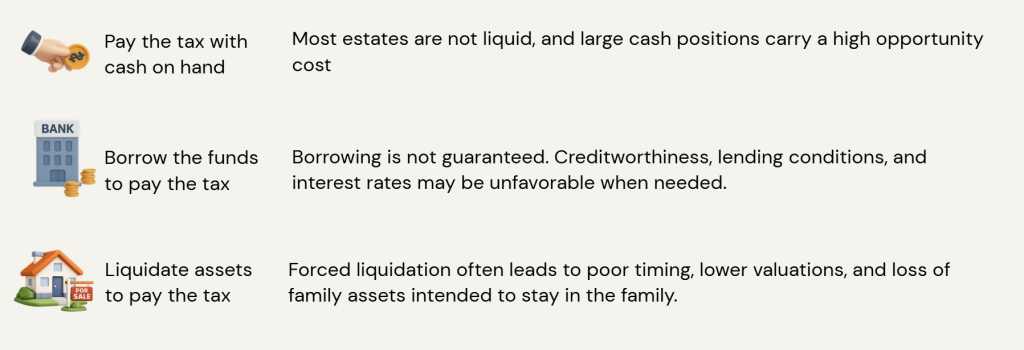
Without planning, the estate would likely need to sell corporate investments or business assets to generate the cash required to pay the tax liability.
The Retained Earnings Challenge
Many successful business owners accumulate significant retained earnings inside a holding company.
Over time, these funds are invested into:
- Public equities
- Fixed income securities
- Real estate
- Private investments
While this allows capital to grow tax-efficiently inside the corporation, it creates a structural problem.
Corporate money eventually needs to become personal money.
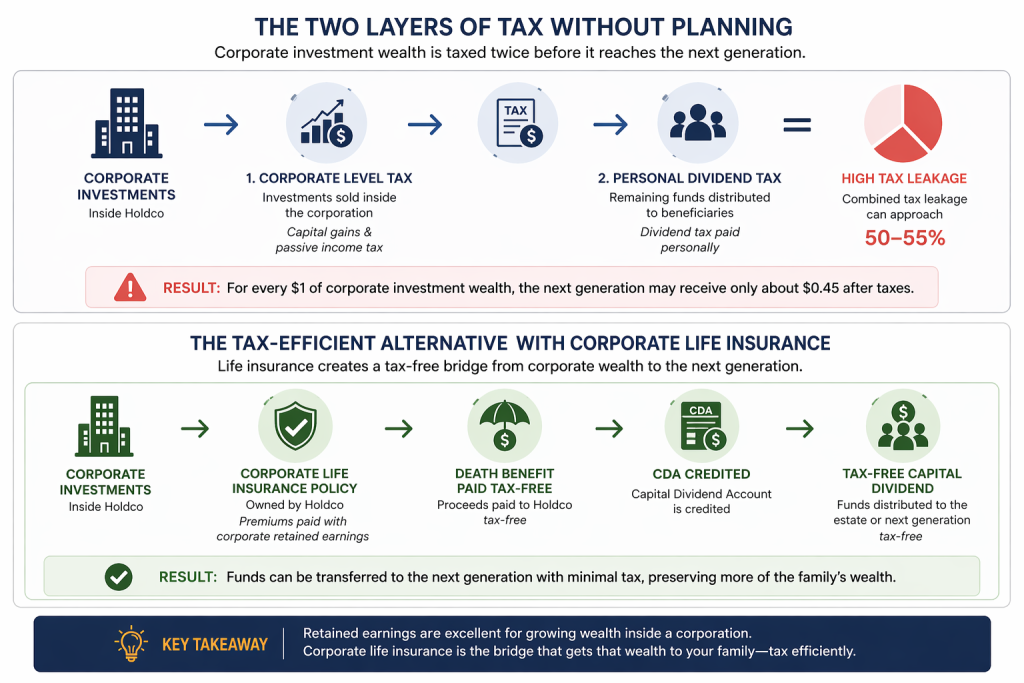
When corporate investment assets are eventually transferred to the next generation, two levels of tax typically apply.
The Two Layers of Tax
- Corporate tax when investments are sold inside the corporation
- Personal dividend tax when the remaining funds are distributed to beneficiaries
In Ontario, the combined tax leakage can approach 50–55%.
This means that for every $1 of corporate investment wealth, the next generation may receive only about $0.45 after taxes.
The Strategy
After reviewing multiple planning scenarios, the advisory team implemented a Holdco-owned participating whole life insurance policy.
The objective was to convert a portion of retained corporate capital into tax-efficient estate liquidity.
Structure Overview
- The life insurance policy is owned by Holdco
- A participating whole life policy was selected for long-term stability
- Premiums are funded using corporate retained earnings
- The policy builds tax-advantaged cash value within the corporation
- The death benefit creates a Capital Dividend Account (CDA) credit
What Happens at Death
Upon Andrew’s passing:
- The life insurance proceeds are paid tax-free to Holdco
- The corporation’s Capital Dividend Account (CDA) is credited
- Holdco can distribute a tax-free capital dividend to the estate
- The funds are used to pay the $2.5M estate tax liability
The investment portfolio and business assets remain intact.
The estate does not need to liquidate investments during unfavorable market conditions.
Why This Strategy Worked
- Created Dedicated Estate Liquidity: ensures taxes can be paid without selling assets
- Converted Retained Earnings into Tax-Free Capital: life insurance allows funds to flow through the Capital Dividend Account
- Preserved the Investment Portfolio: corporate assets remain invested and continue compounding
- Improved Intergenerational Wealth Transfer: funds reach the next generation with significantly less tax leakage
The Traditional Alternatives
Working with Estately Wealth
We partner with Canadian accountants and business owners to design advanced estate planning strategies that preserve corporate wealth and improve intergenerational wealth transfer.
- 20+ Years Experience
- Licensed Across Canada
- Accountant-Friendly Planning
- Corporate Estate Planning
- CDA & Post-Mortem Strategy Support
- Secure Document Repository