
Client Profile
David and Priya Mehta are the founders of a 28-year-old Ontario-based manufacturing company specializing in custom metal fabrication for industrial and infrastructure clients across Southern Ontario.
- Founder age: 63
- Annual revenue: ~$3.2M
- Employees: 18
- Children: Two children, one active in operations, one not involved in the business
- Assets: Majority of family wealth tied to the operating company and retained earnings
Asset Structure
- Principal Residence (Personally Held)
- Fair market value: $2.4M
- Fully protected by the principal residence exemption
- Operating Company (OpCo)
- Enterprise value: ~$4.8M
- Significant retained earnings accumulated over time
- Equipment-heavy business with strong cash flow
- Holding Company (Holdco)
- Invested surplus from OpCo
- Portfolio of marketable securities
- Fair market value: ~$2.1M
Projected Estate Tax Exposure
Upon death, David and Priya’s shares in OpCo and Holdco would be deemed disposed of at fair market value.
Modeled capital gains and corporate tax exposure resulted in an estimated estate tax liability of approximately $2.9M.
The issue was not asset value. It was liquidity.
The Challenge
1. Significant Tax Exposure
The majority of the family’s wealth was embedded in productive assets:
- Growth in enterprise value of the manufacturing business
- Accumulated retained earnings and investment portfolio inside Holdco
- Low adjusted cost base on shares due to long-term ownership
The deemed disposition of shares at death would trigger an estimated $2.9M tax liability.
2. Cash Flow and Working Capital Constraints
The business required:
- Ongoing investment in equipment and production capacity
- Working capital for large contracts
- Flexibility to navigate economic cycles
Selling assets or using retained earnings would:
- Reduce operational flexibility
- Limit reinvestment into growth
- Weaken long-term business value
Using corporate liquidity to pre-fund the problem would come at the expense of growth and flexibility.
3. Legacy and Family Continuity
One child was active in the business, while one was not involved. The founders’ objectives were clear:
- Maintain control with the active child
- Ensure fairness across both children
- Avoid forced sale or external ownership
The IFA Solution
After modeling multiple scenarios, the advisory team implemented a corporate-owned permanent life insurance strategy structured as an Immediate Financing Arrangement (IFA).
Structure Overview
- The life insurance policy was owned by Holdco.
- A permanent participating policy was selected to provide long-term stability and growth of cash value.
- Annual premiums were funded using corporate cash flow.
- A third-party lender provided collateralized financing secured by the policy’s cash value.
- Borrowed funds were deployed for income-producing purposes within the Holdco real estate portfolio.
- Because borrowed funds were used to earn income, the loan interest was structured to be tax-deductible.
At Death
Insurance proceeds would be paid tax-free to Holdco. The Capital Dividend Account would be credited. Tax-free capital dividends could be paid to the estate. The $2.9M tax liability could be funded without selling the business. The loan would be repaid using insurance proceeds, and the operating company would remain intact.
Why the IFA Was Ideal
- Preserved Corporate Liquidity: Maintained working capital, reinvestment capacity, and operational flexibility.
- Enabled Fair Estate Distribution: Created liquidity outside the business to balance outcomes between children.
- Maintained Capital Efficiency: Interest deductibility and continued investment growth inside Holdco.
- Avoided Forced Sale of the Business: Preserved control, continuity, and long-term family wealth.
This structure helped create estate liquidity without forcing the sale of the business.
The Traditional Alternatives
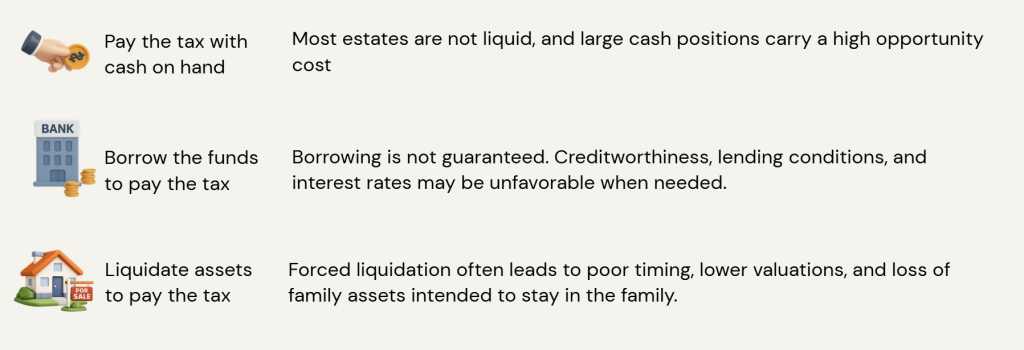
Pay the tax with cash on hand Most estates are not liquid, and large cash positions carry a high opportunity cost. Borrow the funds to pay the tax Borrowing is not guaranteed. Creditworthiness, lending conditions, and interest rates may be unfavorable when needed. Liquidate assets to pay the tax Forced liquidation often leads to poor timing, lower valuations, and loss of family assets intended to stay in the family.
Working with Estately Wealth
Estately Wealth partners with Canadian accountants and advisors to design and implement advanced insurance-based planning strategies for business owners and professionals.
- Expertise in IFA Planning & Implementation
- Licensed Across Canada
- Branded Client Presentations
- Case Consultations on Your Schedule
- Prompt Response Time
- Secure Document Repository
- Annual Accounting Summary
- Post-Mortem Projections & CDA Utilization
We support the planning process with technical expertise, structured analysis, and clear documentation, helping ensure complex strategies like IFAs are implemented correctly and integrated into the broader tax and estate plan.